Projects
Composer Isang Yun
'A Bridge Between Eastern and Western Music'
- Isang Yun is a South Korean composer who is highly regarded in the history of contemporary music as a bridge between Eastern and Western music. During his career in Europe, he composed more than 100 works across a wide range of genres. Drawing on East Asian philosophy, cultural traditions, and the musical aesthetics of traditional Korean music, he created a new and distinctive musical language by combining these influences with European musical idioms and contemporary compositional techniques.
Composer Isang Yun was born on September 17, 1917, in Tongyeong. He studied for two years at the Osaka School of Music and pursued his education between Korea and Japan. In 1944, he was arrested and imprisoned on charges related to anti-Japanese activities.
Following Korea’s liberation in 1945, he organized the Tongyeong Cultural Association with local artists to promote national cultural revival. He worked as a music teacher in Tongyeong and Busan until 1952, and later moved to Seoul in 1953, where he lectured at several universities while continuing his work as a composer. In 1955, he became the first composer to receive the Seoul Culture Award. At the age of 39, he made the decision to study in Europe. He later studied at the Paris Conservatoire and the Berlin University of the Arts, gradually establishing his reputation in the international music world.
However, in 1967, he was forcibly taken to Seoul by the Korean Central Intelligence Agency in connection with the so-called ‘East Berlin Incident’ and suffered imprisonment. He was released in 1969 with the support of the international art community and the government of Germany, after which he became a naturalized German citizen.
In 1972, his opera Sim Cheong opened the Munich Olympic Games, and from then until then until 1994. he created major compositions that deeply embedded East Asian spiritual and aesthetic elements into global contemporary music, including Angel in Flames (1994). In recognition of his artistic achievements, the German government awarded him the Great Cross of Merit.
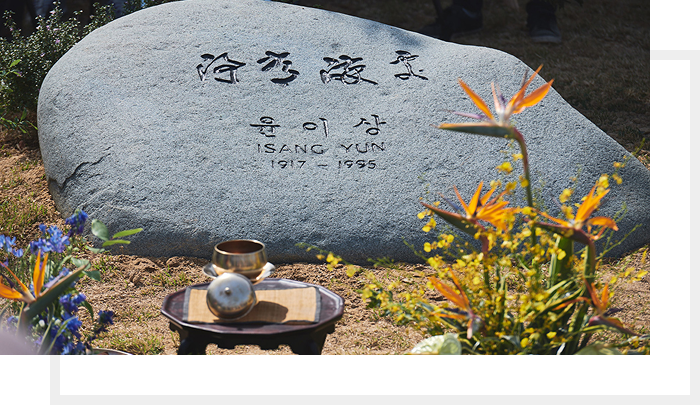
In 1988, he proposed the ‘National Joint Music Festival’, which contributed to the first inter-Korean musical exchanges in 45 years since the division of the peninsula in 1990. Although he contributed in various ways to the democratization and reunification of Korea, he was never able to return to his homeland and passed away on November 3, 1995, in exile. He was buried at the Gatow Cemetery in Berlin, but in March 20, 2018, his remains were returned to his hometown of Tongyeong through an agreement between the city of Tongyeong and the city of Berlin, fulfilling his long-held wish.
Following Korea’s liberation in 1945, he organized the Tongyeong Cultural Association with local artists to promote national cultural revival. He worked as a music teacher in Tongyeong and Busan until 1952, and later moved to Seoul in 1953, where he lectured at several universities while continuing his work as a composer. In 1955, he became the first composer to receive the Seoul Culture Award. At the age of 39, he made the decision to study in Europe. He later studied at the Paris Conservatoire and the Berlin University of the Arts, gradually establishing his reputation in the international music world.
However, in 1967, he was forcibly taken to Seoul by the Korean Central Intelligence Agency in connection with the so-called ‘East Berlin Incident’ and suffered imprisonment. He was released in 1969 with the support of the international art community and the government of Germany, after which he became a naturalized German citizen.
In 1972, his opera Sim Cheong opened the Munich Olympic Games, and from then until then until 1994. he created major compositions that deeply embedded East Asian spiritual and aesthetic elements into global contemporary music, including Angel in Flames (1994). In recognition of his artistic achievements, the German government awarded him the Great Cross of Merit.
In 1988, he proposed the ‘National Joint Music Festival’, which contributed to the first inter-Korean musical exchanges in 45 years since the division of the peninsula in 1990. Although he contributed in various ways to the democratization and reunification of Korea, he was never able to return to his homeland and passed away on November 3, 1995, in exile. He was buried at the Gatow Cemetery in Berlin, but in March 20, 2018, his remains were returned to his hometown of Tongyeong through an agreement between the city of Tongyeong and the city of Berlin, fulfilling his long-held wish.
Cheoyeom-sangjeong (處染常淨)
The inscription on his tombstone, Cheoyeom-sangjeong(處染常淨),
means “remaining unstained even when dwelling in impurity,
preserving one’s original purity.” It symbolizes his life, consistently
guided by an unwavering integrity and noble character.
means “remaining unstained even when dwelling in impurity,
preserving one’s original purity.” It symbolizes his life, consistently
guided by an unwavering integrity and noble character.